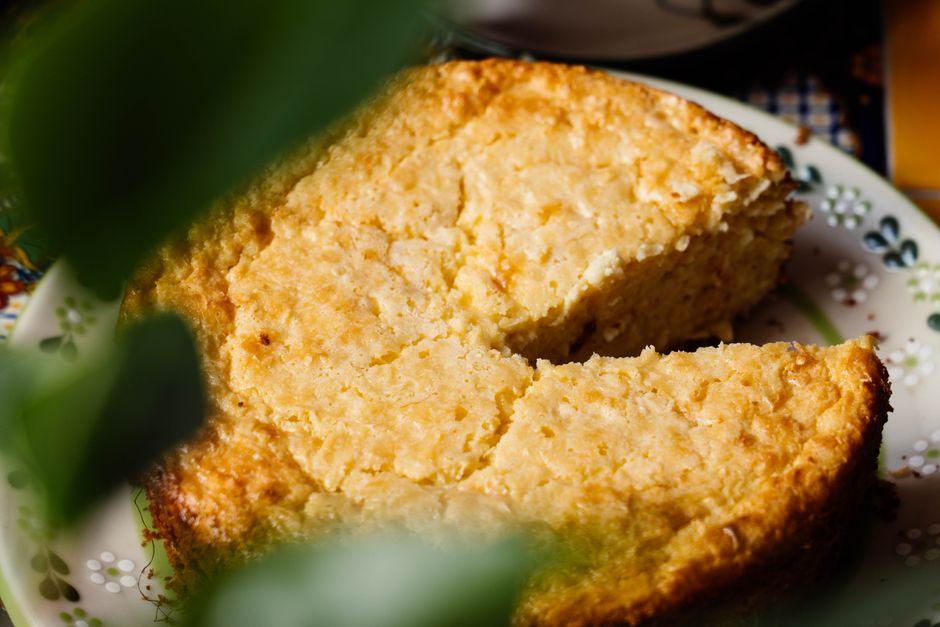
The best forced rhubarb and almond cake uses less fruit than most recipes suggest. Keep the rhubarb to about 250g, dry it well, and bake the cake in a 20cm round tin. That balance gives you sharp pink pieces, a moist almond crumb, and a centre that sets before the edges turn dark. Add 400g of rhubarb and the batter can collapse under the released water.
How much forced rhubarb should go into almond cake?
The reliable fruit-to-batter ratio
For one 20cm cake, use 225g to 275g of trimmed forced rhubarb. Cut the stalks into 2cm pieces, spread them on a clean towel, and press gently to remove surface moisture. Do not salt the rhubarb or soak it in sugar before baking. Both steps pull out more liquid, which makes the cake harder to set.
The recipe below uses 250g rhubarb, 150g unsalted butter, 150g caster sugar, three medium eggs, 175g plain flour, 100g ground almonds, 2 teaspoons baking powder, the zest of one lemon, 1 teaspoon vanilla extract, and a pinch of salt. The almond flour adds fat and softness, while the wheat flour provides enough structure to hold the fruit.
Ingredient choices that reduce risk
Bob’s Red Mill Super-Fine Almond Flour also comes in a 16oz, 454g package. Either product works when weighed rather than measured by volume.
| Ingredient | Weight or measure | What it controls |
|---|---|---|
| Forced rhubarb | 250g, trimmed and cut into 2cm pieces | Sharpness and water level |
| Ground almonds | 100g | Moisture and tenderness |
| Plain flour | 175g | Crumb strength |
| Butter | 150g, softened | Richness and spread |
| Baking powder | 2 teaspoons, about 8g | Lift |
My verdict: 250g is the safest amount for a first bake. It gives the cake a clear rhubarb flavour without turning the middle into fruit pudding.
Why forced rhubarb needs different handling from garden rhubarb
What early forcing changes
Forced rhubarb grows in darkness, often in heated sheds, which produces thin, bright pink stalks with a softer texture. The stalks usually taste less harsh than thick outdoor rhubarb harvested later in spring. That makes them good for cake, where their acidity cuts through butter, sugar, and almonds without needing a large amount of fruit.
The colour is attractive, but colour does not prove freshness. Look for firm stalks with no wet patches, split ends, or limp bends. Store them in the refrigerator for up to five days, wrapped loosely in a reusable bag or damp towel. Remove the leaves completely; rhubarb leaves are not edible.
Why moisture is the main failure point
Rhubarb contains a lot of water. Heat turns that water into steam, and the steam has to escape through the cake before the crumb can set. A deep layer of fruit traps moisture in the centre. A cold cake batter also spreads more slowly, leaving the fruit sitting in one place instead of distributing through the crumb.
Start with room-temperature butter and eggs. Cream the butter and sugar for three minutes, until pale and slightly fluffy. Add the eggs one at a time, then mix in the lemon zest and vanilla. Fold in the flour, almonds, baking powder, and salt only until no dry streaks remain. Fold in two-thirds of the rhubarb, scrape the batter into a lined tin, and scatter the final third over the top.
Do not press the fruit down into the batter. That small mistake creates a wet pocket beneath the top crust. If the rhubarb feels unusually juicy, dust the cut pieces with 1 tablespoon of the measured flour before folding them in. Do not add extra flour beyond that amount; too much creates a heavy cake.
My verdict: drying and distributing the rhubarb matter more than buying a premium almond flour. A basic fine-ground almond flour, weighed accurately, beats an expensive ingredient used carelessly.
Five baking decisions that determine the final crumb
Use this order of operations
- Beat softened butter and caster sugar for three minutes. Stop when the mixture looks pale, not when it becomes completely smooth.
- Add the eggs one at a time. If the mixture curdles slightly, add 1 tablespoon of the flour mixture and continue.
- Fold the dry ingredients in with a spatula. Overmixing develops gluten and leaves the cake rubbery.
- Bake for 50 to 60 minutes. Begin checking at 48 minutes, especially in a dark metal tin.
Read the cake instead of trusting the clock
The top should be golden, the centre should spring back slowly, and a skewer inserted into the cake should come out with a few moist crumbs. A skewer placed directly through a rhubarb piece will look wet even when the cake is ready. Test two spots beside the fruit.
Cool the cake in its tin for 15 minutes, then move it to a rack. Cutting it immediately makes the almond crumb look underbaked because the butter and fruit juices have not settled. Wait at least 45 minutes before slicing.
Fix the common failures
- Wet centre: cover the top loosely with foil and bake for another 10 minutes at 170°C conventional. The next time, use less fruit and dry it longer.
- Burnt edges: lower the oven by 10°C and use a light-coloured tin. Dark tins brown the outside faster.
- Sunken middle: avoid opening the oven before 45 minutes and check that the baking powder is fresh.
My verdict: temperature control and a proper cooling period prevent more failures than extra sugar or a thicker layer of icing.
Can you make forced rhubarb almond cake without changing the recipe?
Can frozen rhubarb replace fresh?
Yes, but thaw it completely and drain it in a sieve for 20 minutes. Press gently with paper towels before weighing 250g. Frozen rhubarb breaks down more quickly, so cut the pieces slightly larger, about 2.5cm, and expect a softer fruit layer. Do not use frozen rhubarb straight from the bag; the ice adds water and lowers the batter temperature.
Can you replace the almonds?
For a nut-free cake, replace the 100g ground almonds with 75g plain flour plus 25g finely ground sunflower seeds. The texture will be less rich and slightly firmer. Coconut flour is not a direct substitute because it absorbs far more liquid. If you use it, the cake may become dry and crumbly.
Can you use outdoor rhubarb later in spring?
Yes. Choose thin, firm stalks and trim away any stringy outer pieces. Later rhubarb can taste sharper, so add 25g extra sugar to the batter or serve the cake with lightly sweetened yogurt. Do not increase the fruit quantity to soften the flavour; that raises the moisture risk without solving the acidity.
My verdict: frozen rhubarb is the best backup when forced rhubarb is unavailable, but fresh early-season stalks produce the cleanest slices and brightest flavour.
The clearest serving verdict for early spring
Serve it warm, but not hot
Warm the cooled cake for 10 minutes in a 150°C oven, then serve it with plain Greek yogurt or lightly whipped cream. The cool dairy softens the rhubarb’s sharp edge without hiding the almond flavour. A dusting of icing sugar is enough; a thick buttercream turns a fresh spring cake into a heavy dessert.
When this cake is the wrong choice
Do not choose this recipe when you need a cake that travels warm, carries a heavy decoration, or keeps for more than three days at room temperature. The fruit makes the crumb tender and limits its shelf life. For a picnic or long transport, a plain almond loaf with rhubarb compote packed separately is safer.
Keep the finished cake airtight at room temperature for two days or refrigerated for four days. Bring refrigerated slices back to room temperature before serving. The opening scenario is simple: a small bundle of pink forced rhubarb arrives in early spring, and the dependable answer is not to use all of it. Use 250g, control the moisture, and you get a cake with a set centre, a tender almond crumb, and enough sharp fruit to make the season unmistakable.