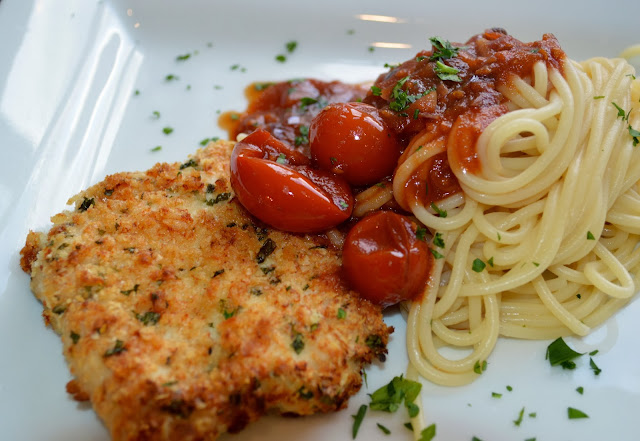
Why This Dish Works
Sharp, salty parmesan crust against a sauce that is acidic and hot — that contrast is the whole point. The cheese melts slightly into the breadcrumb coating as it cooks, binding everything into a golden, crispy shell. The chilli cherry tomato sauce cuts the richness cleanly, no cream required.
Ingredients and Substitutions
This recipe serves 2. Double everything for 4 people, but use two pans rather than crowding one — more on why that matters below.
For the parmesan crusted chicken
- 2 chicken breasts, boneless and skinless (around 180g each)
- 50g Parmigiano-Reggiano DOP, finely grated from a wedge — not pre-grated from a tub
- 40g panko breadcrumbs (Kikkoman Panko, around £1.50 for 200g, gives the lightest result)
- 2 tablespoons plain flour
- 1 egg, beaten
- 1 teaspoon garlic powder
- Salt and black pepper to taste
- 2 tablespoons olive oil for frying
For the chilli cherry tomato sauce
- 250g fresh cherry tomatoes, or one tin of Mutti Cherry Tomatoes (400g, around £1.80)
- 2 garlic cloves, thinly sliced
- 1–2 red chillies, deseeded and finely sliced (or half a teaspoon of dried chilli flakes)
- 1 tablespoon olive oil
- Small handful fresh basil, torn
- 1 teaspoon caster sugar
- Salt to taste
Substitutions that actually work
| Original ingredient | Substitute | What changes |
|---|---|---|
| Parmigiano-Reggiano DOP | Pecorino Romano or Grana Padano | Pecorino is sharper and saltier; Grana Padano is milder — both bind the crust properly when freshly grated |
| Kikkoman Panko breadcrumbs | Regular dried breadcrumbs | Less crunch, denser crust — still works, just reduce heat slightly to avoid burning |
| Fresh cherry tomatoes | Cirio Cherry Tomatoes (tinned, around £1.60) | Slightly sweeter, less texture — skip the caster sugar or use only a pinch |
| Fresh red chilli | Half teaspoon dried chilli flakes | Less fruity heat, more uniform spice — add at the same point in the recipe |
| Chicken breast | Boneless, skinless chicken thigh | More forgiving and juicier — extend oven time to 25 minutes and check temperature hits 75°C |
Getting the Parmesan Crust to Stay On
Most home cooks lose half the crust in the pan. It always comes down to one of three things: wet chicken, skipping the flour stage, or flipping too early. Fix all three and the crust holds from pan to plate.
Pat the chicken completely dry
Take the chicken out of the fridge 20 minutes before cooking. Then pat every surface with kitchen paper — not a quick press, but a thorough dry. Moisture trapped between the meat and the coating turns to steam in the pan. That steam lifts the crust off from the inside, and there is no recovering from it once it starts.
For the most even crust, butterfly the breasts or bash them to a consistent 1.5cm thickness using a rolling pin. Uniform thickness means the whole crust contacts the pan at the same time. It also shortens cooking, which shrinks the window in which the coating can detach.
Grate the parmesan yourself — this is not optional
Pre-grated parmesan, especially the shelf-stable kind in green tubes, contains anti-caking agents (usually cellulose powder) that stop it melting. It stays granular in the pan instead of binding into the crust. It falls off.
Freshly grated Parmigiano-Reggiano DOP — look for a wedge with the dotted rind, typically £4–£6 per 100g from a deli counter or supermarket cheese section — melts slightly when it hits the hot pan. That slight melt is what glues the crust to the egg wash beneath it. Keep the ratio roughly 50:50 parmesan to panko by weight. More parmesan gives a denser, darker, intensely cheesy crust. More panko gives a lighter result with less flavour. Both work; the 50:50 split is the sweet spot.
Three-stage coating in the correct order
Flour, then egg, then the parmesan and panko mix. This sequence is not interchangeable.
The flour layer dries the surface of the chicken slightly and gives the egg something to grip. Without it, the egg slides off the meat. Without the egg, the parmesan and panko have nothing to adhere to. The flour also absorbs any remaining surface moisture the paper towel missed.
After coating, rest the chicken on a wire rack for 5 minutes before it goes into the pan. This lets the coating set and firm up. Going straight from coating to pan means the coating is still wet and fragile — it will pull apart at the first contact with oil.
One more step people skip: press the coating on. After dipping in the parmesan and panko mix, use your palm to press both sides firmly. That compression makes a real, measurable difference to how well the crust holds during cooking.
Building the Chilli Cherry Tomato Sauce
Start this sauce 10 minutes before you begin the chicken. It needs time to reduce and concentrate. A watery tomato sauce poured over a crispy crust is one of the more deflating outcomes in cooking.
Which cherry tomatoes give the best result?
Fresh cherry tomatoes work brilliantly when properly ripe — sweet, deeply coloured, slightly soft to the touch. Out of season, they are watery and pale, and no amount of cooking time fixes that.
For a consistent result year-round, Mutti Cherry Tomatoes (tinned, £1.80 for 400g at most UK supermarkets) are the better call. They are harvested at peak ripeness and have a concentrated sweetness that off-season supermarket tomatoes cannot match. Cirio Cherry Tomatoes (around £1.60) work almost as well and are easier to find. If you use fresh, score the skins and blister them in a dry pan for 3–4 minutes before adding oil and garlic — this deepens the flavour and helps the skins break down into the sauce faster.
How spicy should this actually be?
One deseeded red chilli gives background warmth — present but not distracting. Two deseeded chillies, or one with seeds left in, produces a proper heat that pushes back against the saltiness of the parmesan. That second option is the more interesting dish.
Do not use jarred chilli paste as a shortcut here. It adds a fermented flavour that clashes with the fresh tomato. Dried chilli flakes are a cleaner substitute if fresh is unavailable.
Add the garlic and chilli to cold oil, then turn on the heat. Bringing them up slowly draws out the flavour without burning the garlic. Add garlic to a screaming-hot pan and it browns in under 30 seconds and tastes bitter for the rest of the recipe.
When does the basil go in?
At the very end, off the heat entirely. Basil cooked longer than 30 seconds loses almost all its fragrance and turns dark. Tear the leaves rather than cutting — a metal knife oxidises basil quickly and darkens the edges. Add it just before plating.
The teaspoon of caster sugar in the sauce balances acidity, not adds sweetness. Taste before adding it. Tinned tomatoes are often sweet enough already — if they are, skip the sugar or use only a pinch.
Cooking Method: Which Approach Gives the Best Crust
| Method | How it works | Crust result | Total time | Best for |
|---|---|---|---|---|
| Skillet-to-oven | Sear 3 min per side at medium-high, then oven at 200°C fan for 8–10 min | Deep golden, very crispy base and sides | ~20 min | Best overall result — use this |
| Full oven | Wire rack at 220°C fan for 18–22 min, no searing | Even golden all over, less crispy base | ~25 min | Cooking 4 or more pieces at once |
| Pure pan-fry | Fry each side 5–7 min on low-medium heat, covered | Darker base, lighter top | ~15 min | When you do not want to use the oven |
Skillet-to-oven: the exact steps
Preheat the oven to 200°C fan / 220°C conventional. Heat a cast iron or stainless steel skillet over medium-high heat for 2 full minutes, then add 2 tablespoons of olive oil. Place the coated chicken presentation-side down. Do not move it for 3–4 minutes. Flip once. Transfer the entire pan to the oven for 8–10 minutes until a meat thermometer reads 75°C at the thickest point. Rest 3 minutes before plating.
Use cast iron or stainless, not non-stick. Non-stick pans do not reach the temperatures needed to properly brown the crust. Preheat the pan for a full 2 minutes — an under-heated pan is the most common reason the chicken sticks and the crust tears when flipped.
Five Mistakes That Ruin Parmesan Crusted Chicken
- Not drying the chicken properly. Surface moisture creates steam under the crust and lifts it off. Use kitchen paper and press firmly — a quick blot is not enough.
- Using pre-grated parmesan from a tub. The anti-caking agents stop it melting. It does not bind to the crust. Freshly grated Parmigiano-Reggiano DOP is the only version that works correctly here.
- Flipping before the crust is ready. A properly formed crust releases itself from the pan when done. If it sticks when you try to flip it, it is not ready. Wait. Forcing it tears the crust and it will not recover.
- Crowding the pan. Two chicken breasts per 28cm skillet, maximum. Any more and the pan temperature drops, the chicken steams instead of searing, and the crust comes out pale and soft. Use two pans or cook in batches.
- Pouring the sauce over the chicken too early. The sauce should go on the plate, under the chicken — not ladled over the top at the table. Sauce sitting on a crispy crust softens it within two minutes. All the work of building that crust becomes irrelevant.
The last mistake is the one that catches people even when they have done everything else right. Great crust, ruined at the plating stage.
How to Plate and Serve This Dish
Spread the tomato sauce across the plate first, then place the chicken on top — never the other way around. This keeps the base of the crust dry and the top exposed. You get sauce in every bite without the coating turning soft. It also looks better.
What to serve alongside
Three things work well: a rocket salad dressed with lemon juice and Filippo Berio Extra Virgin Olive Oil (£4–£5 for 500ml), grilled courgette, or plain steamed green beans. The dish is substantial enough that you do not need a starch alongside — but if you want one, a small portion of orzo or a piece of sourdough to drag through the remaining tomato sauce is exactly right.
Avoid mash or anything creamy. They compete with the richness of the parmesan instead of cutting through it, and the whole balance of the dish tips the wrong way.
Reheating without wrecking the crust
Do not microwave it. The crust turns soggy in under 90 seconds. Reheat in an oven at 180°C for 10–12 minutes on a wire rack, uncovered. The crust will not be as crispy as it was fresh but it will hold and remain worth eating.
Store any leftovers with the sauce separate. Chicken sitting in sauce overnight loses the crust entirely. Keep them in different containers and reheat the sauce separately on the hob before serving.
Get the parmesan grated fresh and keep the sauce off the crust until the moment it hits the table — those two steps decide whether this dish succeeds or not.