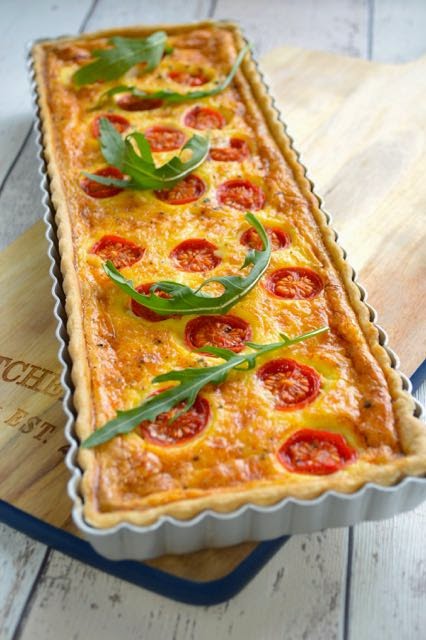
Quiche consistently ranks as one of the most-searched savoury bakes on UK recipe sites, yet the complaints in the comment sections are nearly identical across every published version: soggy pastry, rubbery custard, bland filling. The combination of cherry tomatoes, aged cheese, and red onion marmalade is genuinely one of the best things you can put inside a shortcrust case — sweet, sharp, rich, and savoury all at once. But three specific technique errors quietly ruin most attempts, and none of them get addressed clearly.
This covers all three, along with exact temperatures, specific product recommendations, and the full method.
Why These Three Ingredients Work Together
The pairing isn’t accidental. Each component fills a gap the others leave open — and understanding why helps you make better decisions when something goes wrong.
Red onion marmalade contributes deep, wine-like sweetness. Not the sharp bite of raw onion, not the flat caramel of simply fried onion, but something more complex that emerges when onion sugars and balsamic vinegar reduce together over low heat for a long time. That complexity is the backbone of the whole quiche. It’s also why spreading the marmalade directly onto the blind-baked pastry base — rather than stirring it through the custard — gives a far more pronounced result. Mixed into the custard, it dilutes and disappears. Layered underneath, it concentrates.
Cherry tomatoes supply the acidity the dish needs. The custard is rich: egg yolks, double cream, aged cheese. Without something sharp cutting through that richness, the finished quiche tips into stodgy. Cherry tomatoes balance it more effectively than larger varieties because they concentrate during baking instead of releasing liquid into the filling. Their malic and citric acids stay bright even after 35 minutes at heat.
Why Small Tomatoes Beat Larger Varieties Here
Standard plum tomatoes or sliced beef tomatoes contain far more free water. During baking, that water migrates downward through the custard and sits against the pastry base — it doesn’t drain out, it steams from underneath. The result is a softened, damp base even after proper blind baking. Cherry tomatoes — specifically smaller varieties like Waitrose Essentials Cherry Tomatoes (~90p/300g) or M&S Piccolo Cherry Tomatoes (~£1.80/250g) — have a much higher skin-to-flesh ratio and hold their structure. Always halve them cut-side up. Left whole, the skin traps steam and they burst unpredictably; left cut-side down, they release liquid directly onto the custard surface.
How the Cheese Functions Beyond Flavor
Grated aged cheese in a quiche isn’t only a flavoring element. The proteins in melted cheese help stabilize the custard as it sets — they reinforce the egg protein network and reduce the likelihood of cracking. This is partly why cheese-free quiches are more structurally fragile. The fat content matters too. A higher-fat cheese like Gruyère AOP adds richness that rounds out the sharpness of both the tomatoes and the marmalade without making the custard taste greasy. Lean cheeses — reduced-fat cheddar, for instance — won’t give the same result. The fat-to-protein ratio changes the texture noticeably and the flavor becomes thinner.
Temperature and the Custard’s Behaviour
The custard sets between 70°C and 82°C. Below that range and the proteins don’t coagulate fully; the centre stays loose. Above 82°C and the proteins over-coagulate — you get a grainy, curdled texture and sometimes visible liquid separating from the solids. A low oven, 160°C fan (180°C conventional), keeps the filling inside that setting window long enough for the whole quiche to cook evenly. Most published recipes suggest 185–190°C. That is almost always too high, and it produces the classic problem: rubbery outer ring, runny centre. The tomatoes also burst rather than roasting at those temperatures, releasing water you don’t want.
Red Onion Marmalade: Which Brands Actually Work
You don’t need to make your own for this quiche to be excellent. Several widely available UK options are genuinely good. The differences between them are real and do affect the final flavor balance.
| Brand | Price | Sweetness Level | Acidity Balance | Verdict for Quiche |
|---|---|---|---|---|
| Tracklements Red Onion Marmalade | ~£3.50 / 310g | Medium | Well-balanced | Best all-round choice |
| Bonne Maman Onion Chutney | ~£3.00 / 370g | High | Low | Too sweet — use 1 tbsp only |
| The Bay Tree Caramelised Red Onion Chutney | ~£4.00 / 290g | Medium-high | Medium | Works, edges toward sweet |
| Homemade (red onion, balsamic, brown sugar) | ~£1.20 ingredients | Adjustable | Adjustable | Best result if you have 45 minutes |
Tracklements Red Onion Marmalade is the clearest recommendation from the shop-bought options. Its vinegar balance is more restrained than Bonne Maman’s version, which leans noticeably sweeter — sweet enough that two tablespoons in a quiche start to fight the cheese rather than work with it. If Bonne Maman is what you have, use one tablespoon instead of two and the balance corrects itself.
Making Your Own: The 45-Minute Method
Homemade gives you full control and costs less than a jar. Slice four large red onions thinly. Cook low and slow in two tablespoons of olive oil for 20 minutes — this step cannot be rushed; raw-tasting onion in the finished quiche is one of the harder things to correct after the fact. Add three tablespoons of dark brown sugar, two tablespoons of balsamic vinegar, and one tablespoon of red wine vinegar. Cook uncovered on low heat for another 20–25 minutes until thick and jammy, coating the back of a spoon. Season with salt and a pinch of dried thyme. Cool completely before use — hot marmalade applied to a warm pastry base will begin cooking the custard from below and alter the set.
The Right Cheese Is Not a Preference — It’s a Decision
Use a 50/50 blend of Cathedral City Extra Mature Cheddar (~£4.50/400g) and Gruyère AOP (~£4.50/200g, available at Waitrose and Ocado). The cheddar delivers sharpness and depth. The Gruyère melts cleanly and adds a faint nutty note that harmonises with the sweetness of the marmalade in a way cheddar alone doesn’t manage.
Cheddar on its own works, but it reads as one-dimensional next to the complex sweetness of the marmalade. Gruyère on its own is delicious but pushes the cost higher than necessary. The blend hits both goals at a reasonable price.
Avoid mozzarella — it releases water during baking and makes the custard wet. Avoid soft goat’s cheese unless you want a fundamentally different quiche where the tang dominates everything. Parmesan works only as a surface layer: scatter one tablespoon over the top before baking for a more golden, slightly crustier finish. Used in bulk as the main cheese, it’s too salty and too dry.
Total cheese for a 23cm tin: 150g. Grate it coarsely. Pre-grated supermarket bags are fine — the anti-caking starch doesn’t affect melt noticeably in baked applications.
The Full Method With Exact Measurements
These quantities are for a 23cm loose-bottomed fluted tart tin, approximately 3cm deep. All temperatures are fan-assisted unless stated otherwise.
- Pastry: Use Jus-Rol Shortcrust Pastry Sheets (~£1.80 at Tesco) if you’re not making from scratch — one sheet fits a 23cm tin with minimal trimming. For homemade: 200g plain flour, 100g cold unsalted butter cubed, pinch of salt, 3–4 tbsp cold water. Rub butter into flour to breadcrumb texture, bring together with cold water, wrap and refrigerate 30 minutes. Roll to 3mm.
- Line the tin: Drape the pastry loosely into the tin without stretching it — stretched pastry shrinks back during baking. Press into the edges and let it overhang by 1cm. Refrigerate for 20 minutes.
- Blind bake: Preheat oven to 190°C fan. Line chilled pastry with baking paper, fill with baking beans or dry rice. Bake 15 minutes, remove beans and paper, return for 5 minutes until pale golden and completely dry to the touch. Trim the overhang while still warm using a sharp knife.
- Marmalade layer: Spread exactly 2 tablespoons of red onion marmalade across the warm base. It loosens slightly with the heat and spreads easily and evenly.
- First cheese layer: Scatter 100g of the cheddar-Gruyère blend over the marmalade.
- Custard: Whisk 3 whole eggs plus 2 egg yolks with 250ml double cream and 50ml whole milk. Season with ½ tsp fine salt, a pinch of white pepper, and a very small pinch of nutmeg. Pour slowly over the cheese — slowly enough that the cheese layer doesn’t float up chaotically.
- Tomatoes: Arrange approximately 200g of halved cherry tomatoes cut-side up across the surface. Press them in very slightly so they sit flush with the custard. Scatter the remaining 50g of cheese over everything.
- Bake: Reduce oven to 160°C fan. Bake 30–35 minutes. Edges should be fully set; the centre should retain a very slight wobble. It will firm as it cools — do not wait for it to set completely in the oven.
- Rest: Leave in the tin for at least 20 minutes before slicing. Cutting too early collapses the custard and it runs.
Four Mistakes That Consistently Ruin This Quiche
None of these are obscure. All four are common, and each one is easy to avoid once you know to look for it.
- Skipping the blind bake. There is no workaround. Raw pastry in contact with wet custard becomes permanently soggy within minutes. Blind baking is the only thing that creates a barrier firm enough to hold up through 30+ minutes of baking with liquid filling sitting directly on it. It is not optional.
- Using cold eggs and cream straight from the fridge. Cold custard takes significantly longer to reach setting temperature in the oven. While it warms up, the pastry keeps cooking past the point it needs to. Bring eggs and cream to room temperature — 30 minutes on the counter is enough — before making the custard.
- Too much marmalade. Two tablespoons across a 23cm base. The marmalade is a seasoning layer, not a filling. More than that and the sweetness overwhelms the cheese, and the sticky excess can prevent the custard from bonding properly to the base, which causes it to slide when you slice.
- Baking too hot. 160°C fan. Not 185°C, not 190°C. Higher temperatures cause the egg proteins at the edges to over-coagulate before the centre has even started to set properly — and the tomatoes burst and release water you cannot get back out of the filling.
Serving, Storing, and Reheating Without Ruining the Texture
Does It Reheat Well?
Yes — oven only. Set to 150°C fan and warm for 15 minutes from room temperature, or 20 minutes from cold. The custard returns to something very close to its original texture. Microwave reheating causes uneven protein coagulation: some patches of custard seize and become rubbery while others are barely warm. If a microwave is genuinely your only option, the quiche is better served at room temperature than microwaved. The flavour holds fine cold; the texture does not survive a microwave.
How Far Ahead Can You Make It?
Up to 24 hours in advance, refrigerated. The custard continues to firm overnight and actually becomes easier to slice cleanly the next day — one of the rare recipes that genuinely improves after resting. Cool the quiche completely before refrigerating. Covering a warm quiche traps condensation that softens the pastry top. Use loose foil rather than cling film for the same reason; cling film seals in moisture.
What to Serve Alongside
A sharp salad dressed with a Dijon mustard vinaigrette is the most effective accompaniment — the bitterness cuts through the richness of the custard in a way that a mild, creamy dressing simply doesn’t. New potatoes with butter work well for a more substantial lunch plate. Bread is redundant given the pastry base already provides that element, and it makes the meal heavier than it needs to be.
For a 23cm quiche, plan for six moderate portions or four generous ones. For a 26cm tin, add one extra egg and 50ml more cream — leave every other quantity unchanged and the recipe scales cleanly without adjusting timing by more than two or three minutes.