Buy cheap Stilton and this quiche turns aggressively salty. Buy too much and the custard splits in the oven. Get the leeks wrong and the base goes wet regardless of how carefully you blind bake. This guide covers what actually changes the outcome — specific Stilton brands, exact weights, and the technique failures that account for most bad results.
This is not financial advice. It is, however, strongly worded advice about cheese.
Why Stilton Controls More Than Just the Flavour
Most recipes treat Stilton as a seasoning. Crumble it in, move on. That framing undersells how much structural work the cheese does inside a quiche filling.
Stilton carries around 34–35g of fat per 100g. As the quiche bakes, that fat emulsifies into the custard — eggs, cream, milk — and directly affects how the filling sets. Too much Stilton, or a particularly oily mature variety, and you exceed what the custard can absorb. The result is a greasy, slightly curdled filling with an oily surface. It happens before you’ve done anything obviously wrong. The oven temperature was fine. The recipe looked right. The Stilton was just the wrong choice at the wrong quantity.
The fix isn’t using less cheese arbitrarily. It’s understanding which Stilton type works reliably inside a cooked filling, and at what volume.
Young vs. Aged Stilton: What the Difference Actually Means in an Oven
Young Stilton — around 4 to 6 weeks of ageing — is creamier, less intensely veined, and releases fat gradually when heated. It melts into the custard without separating. Aged Stilton, 8 to 12 weeks, has a sharper bite, a drier crumble texture, and a higher concentration of the volatile compounds that give blue cheese its distinctive intensity.
In a quiche, that intensity gets amplified by cooking. What reads as complex on a cheese board reads as overwhelming when baked at 160°C for 40 minutes. The leek and walnut stop registering. You’re eating a Stilton tart, not a balanced three-ingredient filling.
Target a mid-aged Stilton, around 6 weeks. Ask the cheesemonger directly — that’s what the counter is for. If you’re buying from a supermarket, “mild” or “creamy” on the label is a reliable proxy. Avoid anything marked “mature” or “extra mature” for this specific application.
How Much Stilton to Use — Actual Numbers
For a 23cm loose-bottomed tart tin: 100g to 120g of crumbled Stilton is the working range. Under 80g and the flavour disappears into the custard. Over 140g and you risk fat separation — the cheese overwhelms the other ingredients before the filling has even set.
Most published recipes sit at 150–200g. That’s consistently too much. The custard base — three eggs, 200ml cream, 100ml milk — dilutes intensity significantly, but it has real limits on how much fat it can carry without breaking the emulsion.
Bottom Line: 100–120g of mild to mid-aged Stilton, crumbled evenly over the filling. That’s the range that works reliably every time.
Stilton Brands Compared: What You’re Actually Paying For
Three producers control the premium UK Stilton market. How they perform on a cheese board is a separate question from how they behave inside a cooked custard filling at 160°C for 40 minutes.
| Producer | Fat Content | Texture | Approx. Price (200g) | Verdict for Quiche |
|---|---|---|---|---|
| Colston Bassett | ~34g per 100g | Loose crumble, very creamy | £5.50–£6.50 | Best overall — melts cleanly |
| Cropwell Bishop | ~35g per 100g | Firmer, denser blue veining | £4.50–£5.50 | Good — slightly more intense |
| Long Clawson | ~33g per 100g | Very creamy, mild | £3.50–£4.50 | Best for a crowd — least aggressive |
| Generic supermarket Stilton | Variable | Often drier, more crumbly | £2.50–£3.50 | Risky — check the label carefully |
Colston Bassett is the consistent pick for quiche. It crumbles evenly, melts without splitting the custard, and carries enough flavour complexity to come through cooking without dominating the filling. Cropwell Bishop from their Nottinghamshire dairy is a close second — their standard range works well and usually comes in slightly cheaper.
Long Clawson, widely stocked across most major UK supermarkets, is the right call when cooking for a group where Stilton opinions are unknown. The flavour is present but gentle. It won’t convert anyone who actively dislikes blue cheese, but it softens the edge enough to significantly broaden the dish’s appeal. Generic supermarket own-brand Stilton has inconsistent moisture and fat content — it can work, but it’s a variable you don’t need.
Bottom Line: Colston Bassett for the best result. Long Clawson for the broadest appeal. Either is a better choice than anything labelled “extra mature.”
Leeks: The Variable That Determines Whether the Base Stays Dry
Leeks aren’t the support act in this quiche. They’re the moisture variable that determines whether the custard sets cleanly or produces a wet, unset centre — and a soggy base that no amount of blind baking fixes after the fact.
Raw or lightly cooked leeks hold a substantial amount of water. When they hit oven heat inside a custard filling, that water releases. It dilutes the egg-to-liquid ratio the custard needs to set properly and migrates downward into the pastry base. Sweat leeks over medium-low heat in butter for 15 to 20 minutes, until fully soft, translucent, and slightly collapsed with no remaining bite. No colour — you’re driving out moisture, not adding caramelisation. 300g of raw leeks reduces to around 180g after this step. That weight loss is almost entirely water that would otherwise be in your filling.
Let them cool completely before going into the tart case. Hot leeks begin setting the custard prematurely the moment you pour it in.
Which Part of the Leek to Use
Stick to the white and pale green sections. The dark green tops are tougher, take significantly longer to fully soften at the same temperature, and carry a slightly bitter edge that conflicts with Stilton’s salt and the walnuts’ tannins. A small amount of pale-to-mid green is fine for colour variation, but if your slices are predominantly dark, they introduce texture and flavour problems the rest of the filling can’t compensate for.
Two medium leeks — roughly 300g raw — is the right quantity for a 23cm tart. One leek under-fills the dish relative to the Stilton. Three creates too much bulk against the custard volume and the filling won’t set evenly.
The Pastry Decision Is Straightforward
Make shortcrust from scratch: 200g plain flour, 100g cold cubed butter, 2–3 tablespoons cold water, blind baked at 190°C for 15 minutes with baking beans then 5 minutes uncovered until genuinely golden. Ready-made Jus-Rol shortcrust pastry works in a pinch, but it rolls thinner, produces a more fragile base, and goes soggy faster under a wet filling. For a quiche where the filling is this substantial, the pastry needs structural integrity — homemade delivers that; Jus-Rol does not, quite.
Four Mistakes That Ruin This Quiche Before It Reaches the Table
Is Overcooking the Custard the Biggest Risk?
Yes. The custard — three eggs, 200ml double cream, 100ml whole milk — sets at around 70°C internal temperature. Most recipes specify 35–40 minutes at 160–170°C. The real test isn’t time. Pull the tart when the centre still has a slight, uniform wobble — like set jelly moving as a single unit. It firms up completely as it cools. A rock-solid centre straight from the oven means overcooked. Sliced, it will taste rubbery and noticeably dry, which wastes the Stilton’s flavour and the effort that went into the filling.
When Should the Walnuts Go Into the Filling?
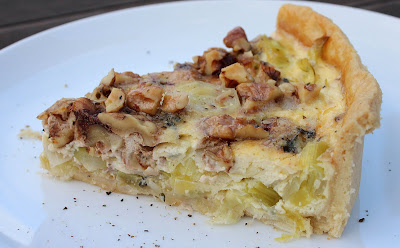
They shouldn’t. Walnuts contain tannins that turn bitter and astringent with sustained oven heat. Folded into the custard, they spend 40 minutes at 160°C and come out mealy. Scattered across the surface, they receive gentler radiant heat and toast lightly — staying crunchy and genuinely nutty rather than turning soft and slightly unpleasant.
Use 40–50g of walnut pieces, not whole halves. A whole walnut half in a single bite dominates everything around it. Broken pieces distribute crunch and flavour more evenly across each slice.
Why Does the Base Go Soggy?
Three causes, ranked by how often they’re actually responsible:
- Underbaked pastry case — it must be visibly golden before filling goes in. Pale and set is not enough. Pale pastry hasn’t cooked through and won’t resist moisture from the filling during baking
- Leeks not properly sweated — the single most common cause, and the most frequently overlooked step in recipes that don’t explain why it matters
- Filling poured into a still-hot pastry case — the case needs at least 10 minutes to cool after blind baking before the custard goes in
Bottom Line: A soggy bottom is always a technique failure, not a recipe failure. Fix the blind bake temperature and the leek prep, and the problem disappears entirely.
When This Quiche Is the Wrong Choice Entirely
Stilton divides people more reliably than almost any other ingredient. A notable portion of the population find cooked blue cheese actively unpleasant — not just unfamiliar, but genuinely off-putting in a way that politeness barely covers. If you’re cooking for a group and you don’t know everyone’s tolerances, this quiche carries real risk of a dish half the table won’t eat.
Swap Stilton for Gruyère — same quantity, identical method — and you get a quiche that’s almost universally accepted. Nutty, melting, savoury without the sharpness. Gruyère also emulsifies into the custard more predictably, has zero risk of the filling separating, and produces a result that reads as sophisticated without requiring any tolerance for blue cheese.
Feta is a different swap worth knowing. It doesn’t melt — it stays in pockets — and it’s saltier, so use 90–100g rather than 120g. The result is a lighter, more Mediterranean-leaning tart. Less rich, still substantial.
For the walnuts: toasted pine nuts are a direct textural substitute for anyone with a tree nut allergy or strong walnut aversion. They lack the bitter-fat contrast that makes walnuts interesting against Stilton, but the dish still holds together structurally and flavour-wise.
UK leek season runs roughly September through April. Late May leeks are often imported, noticeably more expensive, and thinner in flavour. Outside that window, caramelised onions — same weight, cooked down the same way — carry the sweetness role without any change to the broader technique.
The Recipe: Measurements Only, No Narrative
For a 23cm loose-bottomed tart tin. Serves 6.
Pastry
- 200g plain flour
- 100g cold unsalted butter, cubed
- 2–3 tbsp cold water
- Pinch of fine salt
Filling
- 300g leeks, cleaned and sliced — white and pale green only
- 15g unsalted butter
- 110g Colston Bassett or Cropwell Bishop Stilton, crumbled
- 3 large eggs
- 200ml double cream
- 100ml whole milk
- 45g walnut pieces
- Black pepper — no added salt; the Stilton handles seasoning entirely
Method
- Rub cold butter into flour until the mix resembles rough breadcrumbs. Add cold water one tablespoon at a time until it just comes together. Wrap and chill for 30 minutes.
- Roll pastry to 3mm thickness. Line the tin, trim edges, prick the base. Chill for a further 15 minutes.
- Blind bake at 190°C / 170°C fan: 15 minutes with baking beans and parchment, then 5 minutes uncovered until visibly golden. Cool for 10 minutes.
- Sweat leeks in butter over medium-low heat for 15–20 minutes until fully soft and translucent. No colour. Cool completely.
- Whisk eggs, cream, and milk together. Season with black pepper only.
- Spread cooled leeks across the pastry base. Scatter crumbled Stilton evenly over the leeks.
- Pour custard in slowly. Scatter walnut pieces across the surface.
- Bake at 160°C / 140°C fan for 35–40 minutes until just set with a slight wobble at the centre.
- Rest in the tin for 20 minutes before removing. Serve warm or at room temperature.
Refrigerated overnight, the Stilton’s intensity settles and the flavours integrate more fully than they do fresh from the oven. A cold slice the next day, with dressed bitter leaves, makes a stronger argument for this quiche than the version served warm ever quite manages.